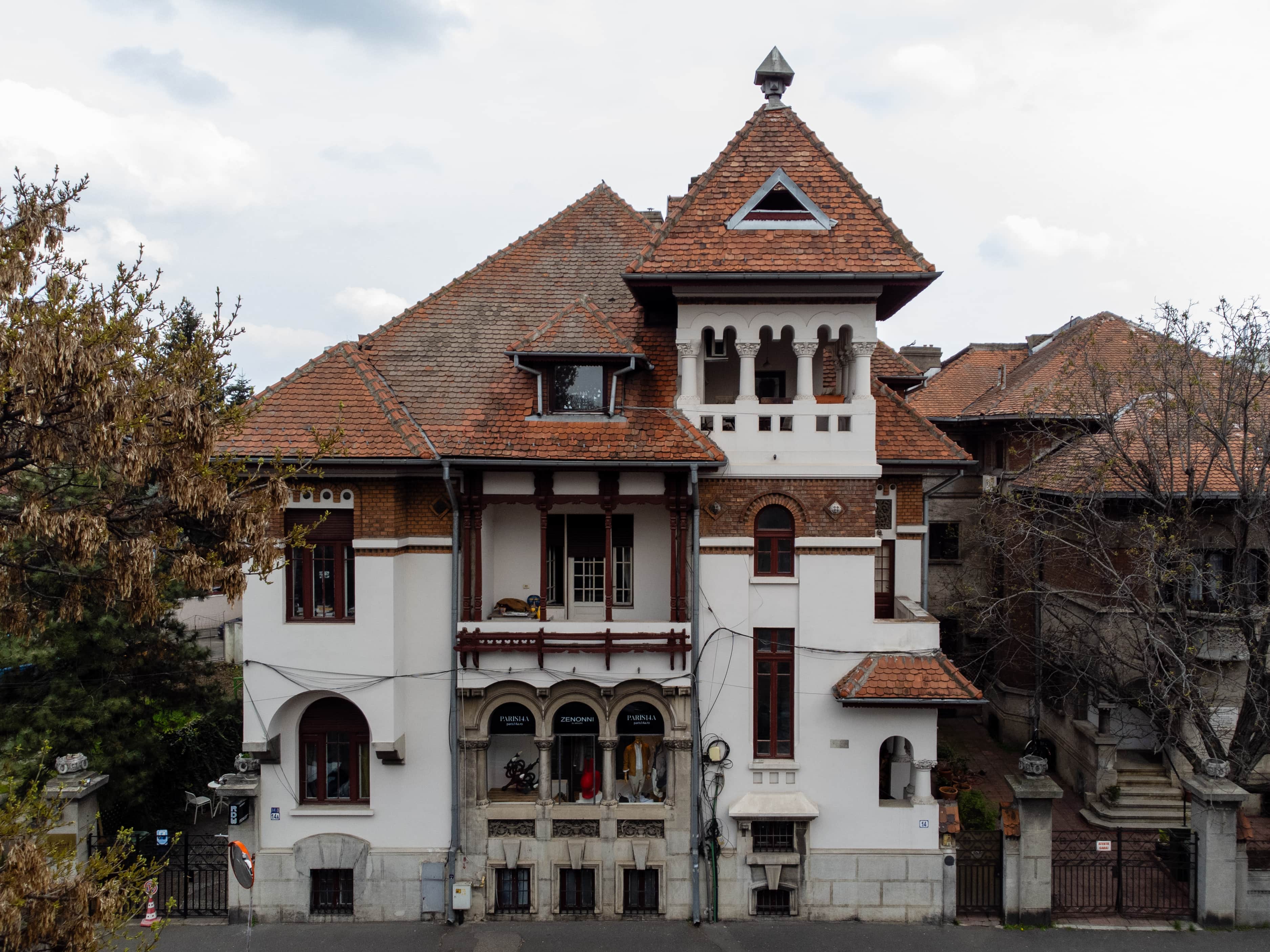
Walk along Bulevardul Dacia on a quiet morning and you will notice something unusual about the buildings. Unlike the Haussmann-inspired facades that dominate central Paris, or the baroque grandeur of Vienna, the houses here carry ornaments that feel almost handmade, carved stone friezes with geometric motifs, broad arches drawn from Byzantine churches, open verandas that echo the wooden porches of Wallachian countryside homes.
This is the Neo-Romanian style. And it is one of architecture's great untold stories.
A movement with a purpose
By the late 19th century, Romania had just emerged from Ottoman suzerainty and was building its identity as a modern European nation. The cultural question of the moment: what should a Romanian building look like? Importing French neoclassicism or German historicism felt like a continuation of foreign influence. A group of architects — led most prominently by Ion Mincu — argued for something different.
Mincu's 1886 Bufetul de la Șosea (the Lahovary House) is widely considered the first fully Neo-Romanian building. Its design drew deliberately from vernacular Romanian architecture: the pronounced overhanging eaves of rural farmhouses, the carved stone details of medieval Wallachian churches like Curtea de Argeș and Cozia, and the wide loggia (a covered outdoor space), that appears in traditional manor houses across the Carpathian regions.
The movement had an explicit nationalist ambition: to create a Romanian architectural language that was both modern and rooted in local tradition. It was, in that sense, a cultural project as much as an aesthetic one.
What to look for on the street
Once you know the vocabulary, Neo-Romanian buildings are immediately recognizable. Look for:
The overhanging cornice. Where Italian Renaissance buildings use thin horizontal cornices, Neo-Romanian structures often have deeply projecting roof lines, borrowed from rural wooden architecture, translated into stone and plaster.
Trefoil and multifoil arches. These three- and four-lobed arches appear in medieval Romanian religious architecture. On residential buildings along Calea Victoriei or Strada Monetăriei, they frame windows and doorways, giving even modest houses a vaguely ecclesiastical solemnity.
Carved stone friezes. The decorative bands below cornices often feature geometric interlace patterns (diamond shapes, braided borders, stylized floral motifs), drawn directly from the ornamentation of 14th and 15th-century Wallachian churches.
The open loggia or foișor. Perhaps the most distinctive element: a semi-open gallery on the upper floor, shaded and fronted by columns with distinctively Romanian capitals. In rural architecture this was a working space; in urban villas it became a statement of identity.
The golden decade: 1906–1916
The style flourished particularly in the decade following the 1906 Jubilee Exhibition in Bucharest, a massive celebration of 40 years of Hohenzollern rule that showcased Neo-Romanian architecture to international visitors. Buildings from this period are the most accomplished: Petre Antonescu's grand Primăria Sectorului 1, Grigore Cerchez's villas in the Cotroceni neighborhood, and dozens of private residences commissioned by the emerging Romanian bourgeoisie along streets like Strada Polonă, Dacia Boulevard, and the area around Parcul Ioanid.
Walking through these streets today, especially in the early morning before traffic thickens, gives a precise sense of what early 20th-century Bucharest looked and felt like. These are not museum pieces. People live in them, businesses operate in them, their plaster cracks and their gardens overgrow. That ordinariness is part of what makes them moving.
What survives and what has been lost
The communist systematization campaign of the 1970s and 1980s destroyed approximately 30% of Bucharest's pre-war building stock. Entire neighborhoods were cleared for the Civic Center and Bulevardul Unirii. Many Neo-Romanian buildings survived only because they were outside the demolition corridor, or because their institutional function made them useful to the state.
The threat today is different: neglect and speculative development. Buildings that survived Ceaușescu are now being hollowed out, sold, and converted or simply left to deteriorate until demolition becomes the practical option. Heritage protection in Romania remains inconsistently enforced.
This is part of why these tours matter. Documentation, attention, and the cultivation of public interest in this architecture are among the few practical tools available. Every visitor who notices these buildings, who photographs them, who asks questions about them, contributes in a small but real way to the argument for their preservation.
If you would like to see the finest examples of Neo-Romanian architecture in person, the Hidden Architectural Tour covers the dense concentration of early 20th-century buildings in the Dacia - Ioanid - Lascăr Catargiu area, the best-preserved stretch of this extraordinary urban tradition.