There is a photograph from 1856 that shows Calea Victoriei as a dirt road with wooden sidewalks, lined by low single-story houses with tiled roofs. Merchants and boyars move along it on horseback. The occasional carriage raises a cloud of dust. In the background, the dome of what would become the Romanian Athenaeum is still decades away from being built.
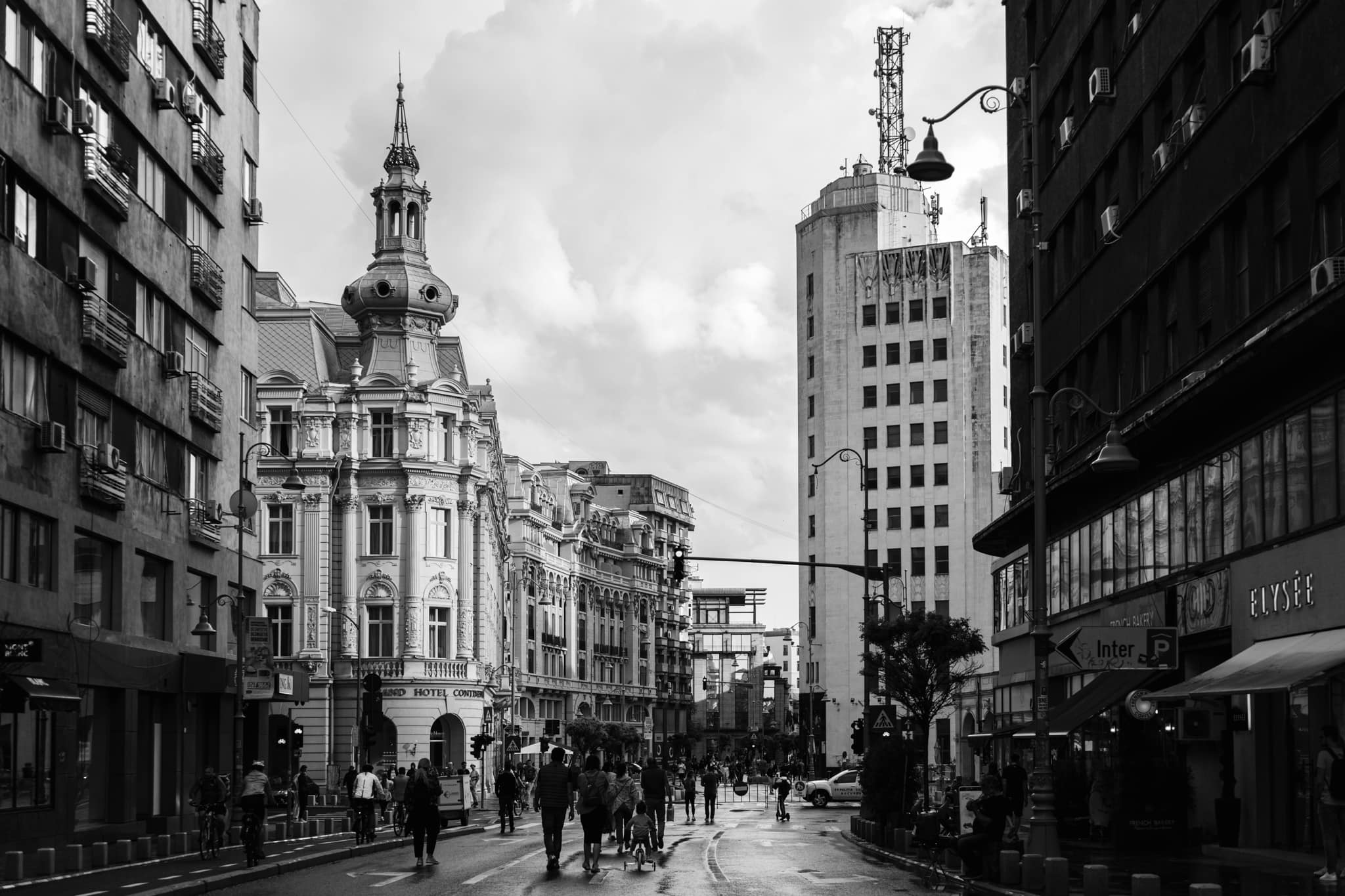
Stand at the same spot today — roughly at the intersection with Strada Doamnei — and you are surrounded by the CEC Palace, the National History Museum, neoclassical bank buildings, and the continuous parade of renovation scaffolding that seems to be a permanent feature of Bucharest's central streets. The transformation across those 170 years is among the most dramatic in European urban history.
The beginning: Podul Mogoșoaiei
The street's original name was Podul Mogoșoaiei — literally "Mogoșoaia Bridge," though "pod" in old Romanian referred to a plank-paved road rather than a bridge over water. It was built in the early 18th century on the orders of Constantin Brâncoveanu, the Wallachian prince, to connect Bucharest's commercial center with his palace at Mogoșoaia, 15 kilometers to the north.
The road was essential to the city's commercial life. It connected the market at the southern end — where the Old Town's hans and bazaars clustered — with the boyar residences and later the princely court to the north. For most of the 18th and early 19th centuries, this meant navigating a street that was unpaved, seasonally impassable, and lined with a chaotic mixture of churches, taverns, merchant warehouses, and aristocratic palaces.
The Paris of the East takes shape
The transformation came with Alexandru Ioan Cuza's reforming reign (1859–1866) and accelerated under Carol I. The unification of the Romanian Principalities created a new national capital that needed to look the part. French urban planners and Romanian architects educated in Paris returned with a vision: Bucharest would be rebuilt in the image of Haussmann's Paris.
Calea Victoriei — renamed after the 1877 Independence War — became the showcase of this ambition. The Romanian Athenaeum (1888), the CEC Palace (1900), the Cercul Militar (1912), the Palatul Telefoanelor (1933): these buildings were placed along or just off the street with deliberate civic intent. They were meant to announce that Romania had arrived as a modern European nation.
What makes Calea Victoriei architecturally extraordinary is precisely the layering that resulted. Unlike Haussmann's Paris, which was largely built at a single moment according to a unified vision, Bucharest's central avenue accumulated buildings across nearly three centuries — each one reflecting the taste, politics, and economic conditions of its moment. The result is a street where Ottoman-era churches stand next to Beaux-Arts banks, Art Deco apartment buildings face neoclassical ministry palaces, and communist-era insertions punctuate the 19th-century fabric like typographical errors.
The passages: Bucharest's hidden interior
One of the least-visited aspects of Calea Victoriei is its system of covered passages — the galeries that branch off the main street into networks of small shops, offices, and occasionally cafés. The most celebrated is the Macca-Vilacrosse Passage (1891), a Y-shaped covered arcade with a glass roof and yellow cast-iron details, tucked behind the National Bank building. Few tourists find it; most Bucharesters have walked past the entrance dozens of times without noticing the turn.
These passages were built on the Parisian model — the same galeries that Benjamin wrote about in his Arcades Project. In Bucharest, they served a slightly different social function: partly as sheltered shopping arcades, partly as informal meeting places for the commercial and professional classes who worked in the buildings along the street. Several have survived in various states of preservation. Others were sealed and forgotten during communism, their entrances bricked over or converted to other uses.
The communist interruption
Calea Victoriei escaped the worst of Ceaușescu's systematization — the demolitions were concentrated further south, around the Civic Center. But the communist decades left their mark in subtler ways: ground-floor shops converted to state offices, residential buildings nationalized and subdivided into apartments, maintenance deferred until facades began to fail.
The buildings along Calea Victoriei today exist in a complicated condition: magnificent in their bones, often decrepit in their surfaces, being slowly and unevenly restored by a mixture of private investment, state funding, and benign neglect. Walking the street carefully — looking up at the upper floors rather than at the retail signage at eye level — gives a precise sense of this layered condition.
Reading the street
The Calea Victoriei tour I lead begins at the Athenaeum and ends at Piața Națiunile Unite, but the point is not to cover the distance — it is to stop, repeatedly and deliberately, at the details that reward attention: the terracotta ornaments above a door that date to the 1890s; the ghost of a painted advertisement on a side wall; the courtyard behind a gate that opens onto an entirely different architectural world than the street outside.
Calea Victoriei is not a museum. It is a living street with terrible traffic and excellent coffee. But it is also, if you know how to read it, a compressed history of everything Romania has been and aspired to be over the past five centuries. That is what makes it worth three hours of careful attention.