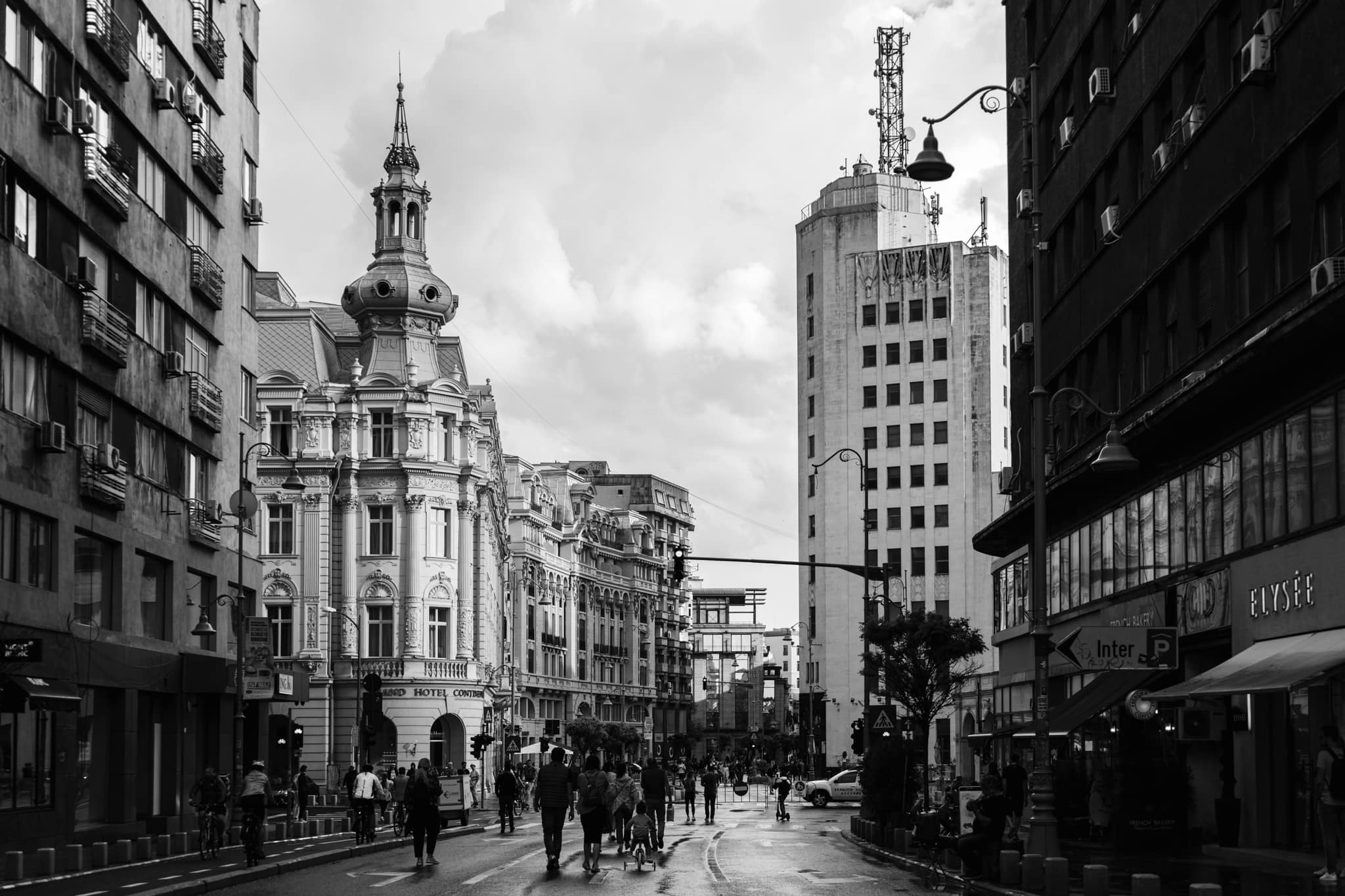
Bucharest has a photography problem: most images of the city look the same. Palace of Parliament from the boulevard. Ateneul Român at golden hour. Old Town cobblestones. These are beautiful images. They are also, at this point, thoroughly catalogued.
What this guide is about is everything else. The locations where Bucharest's architectural complexity becomes legible through a lens. The details, the light, the layering that makes this city genuinely different from anywhere else in Europe.
Understanding Bucharest's architectural light
The city sits at roughly the same latitude as Bordeaux, which means long summer evenings and low winter light. The best architectural photography happens:
- Morning (7–9am): Low raking light from the east illuminates façade reliefs and creates strong shadows on carved ornament. The streets are empty. The light on Dacia Boulevard at 7:30am in autumn is extraordinary.
- Late afternoon (4–6pm): West-facing façades on Calea Victoriei glow. The Athenaeum colonnade picks up warm reflected light.
- Overcast days: Often better than direct sun for façade detail. So there are no harsh shadows, even illumination, colours read true.
The locations
Strada Blanari and the Old Town fabric
The Old Town (Lipscani) is correctly famous for its nightlife. Its architecture is less discussed. Strada Blanari, Strada Covaci, and the streets immediately east of it contain some of the best-preserved 18th and 19th-century urban fabric in the city. The scale is intimate, the details are extraordinary, and at 8am on a weekday you will have it entirely to yourself.
What to look for: Ottoman-era ground floors with 19th-century residential additions above. Carved stone lintels. The relationship between street width and building height, a ratio that hasn't changed since the 18th century.
Dacia Boulevard - Parcul Ioanid section
The 600-metre stretch of Dacia Boulevard between Strada Vasile Lascăr and Parcul Ioanid is the highest concentration of Neo-Romanian residential architecture in the city. Every building is different. The ornamental details (carved stone, glazed ceramics, decorative ironwork), reward macro photography.
Light: Best from the north side of the street in morning, south side in afternoon.
Pasajul Macca-Vilacrosse
The amber glass roof of this 1891 covered passage creates a quality of light that is genuinely unlike anything else in the city. On a sunny day, the light through the yellow glass is warm and diffused. The passage is best photographed from its eastern entrance, looking west toward the branching Y-junction.
When to go: Mid-morning on a weekday. By 11am it fills with office workers.
Calea Victoriei - upper section
The kilometre between Piața Victoriei and Piața Romană contains, in rapid succession: Secession, neoclassical, Neo-Romanian, modernist, and brutalist buildings. The compression of styles makes it one of the most visually complex streets in Europe.
What to look for: The relationship between ground-floor commercial interventions and the original upper-floor architecture. The patina on the stone. The way buildings from different eras negotiate shared party walls.
Cotroceni neighbourhood
West of the botanical garden, the residential streets of Cotroceni contain villas from the 1910s-1940s that have survived relatively intact. The area is quiet, leafy, and almost entirely untouristed. The combination of mature vegetation and eclectic architecture produces the closest thing Bucharest has to a garden suburb.
Best months: April - May (flowering trees) and October - November (autumn colour against stone façades).
Interior courtyards
Many of Bucharest's most extraordinary architectural spaces are invisible from the street. The courtyard of the Pasajul Villacrosse. The inner garden of Casa Capșa. The courtyard of several Dacia Boulevard villas. These are accessible, most are not locked, but they require the confidence to walk through an unmarked gate.
A guide is useful here not for information but for permission: knowing which gates to try.
Technical notes
- A 35mm or 50mm prime is more useful in Bucharest than a wide-angle. The streets are narrow enough that distortion becomes a problem.
- A polariser helps cut reflections from the glazed tile ornaments common in Neo-Romanian architecture.
- The city's uneven pavement is hard on tripods. A monopod or image stabilisation is worth the investment.
Photography-focused private tours are available through București Din Povești. Routes can be customised around specific architectural periods, light conditions, or photographic interests. From €50 per person.